
AI is Making Features Cheaper, and Systems More Valuable
AI Is Making Features Cheaper and Systems More Valuable
Nearly one-third of companies say they have already decided not to buy at least one software product or feature because they could build the functionality themselves using agentic coding tools.
That finding, from McKinsey’s latest State of AI research, says a lot about where enterprise software may be heading. Building software internally has traditionally been an expensive proposition. It required development resources, infrastructure, time and an ongoing commitment to maintain what was built. Even when commercial software wasn’t perfect, buying was often the more practical choice.
AI is changing the economics. Coding agents are reducing the time and expertise needed to build software, foundation models provide capabilities that would have required significant development only a few years ago, and companies can combine those capabilities with their own data and systems.
Customers aren’t suddenly going to start building all of their own software. But they may become much more selective about what they are willing to buy. If a team can reproduce enough of a capability internally, or assemble something good enough from technology it already owns, another application or license becomes harder to justify.
For product companies, that has consequences well beyond AI strategy. It changes where differentiation comes from and, ultimately, what makes a product valuable.
Features Are Becoming Easier to Reproduce
Features have always been an important source of competitive advantage in software. A company could identify an unmet customer need, build a capability to address it and enjoy a meaningful lead until competitors caught up. Product roadmaps reflected that reality, with much of the competitive battle centered on who could deliver the best set of capabilities.
That model isn’t going away, but the useful life of feature-level differentiation is likely to get shorter.
AI makes it easier to develop new functionality, but that is only part of the change. Customers also have access to increasingly capable foundation models, APIs, open-source technology and existing enterprise platforms that can be combined to solve problems that once required a dedicated application.
As a result, the traditional build-versus-buy decision is becoming more complicated. A customer can buy a product, build something internally, assemble a solution from existing technologies, or decide that what it already has is good enough.
That means a product’s competition may not always be another product. It may be a capability created by an internal team, an agent connected to existing systems, or functionality bundled into a platform the customer already owns.
For products whose primary advantage is a list of features, that creates a real challenge. Matching a competitor’s functionality is one thing. Competing with a customer who decides it no longer needs to buy that functionality at all is something else.
The Application May No Longer Define the Product
There is another change happening at the same time. AI is beginning to alter the way people interact with enterprise software.
Salesforce’s recent introduction of Headless 360 is a useful example. It allows AI agents to access Salesforce capabilities without requiring the user to work through the traditional Salesforce interface.
For most of the software era, the application has been both the product and the primary way people experience it. Users open the application, navigate to the appropriate function, provide information and tell the software what they want it to do.
AI introduces a different interaction model. A person can increasingly express what they are trying to accomplish and allow an AI system to work across the applications and capabilities required to get it done.
The underlying software remains important, but much of its value may sit behind the experience rather than inside the interface. Data, permissions, business rules, integrations, workflows and transaction capabilities become the foundation that an AI system can draw upon.
This creates an important product strategy issue. If customers increasingly access software capabilities through AI interfaces, including interfaces owned by other companies, then the application itself may become a less durable source of differentiation.
The value has to come from something deeper.
The Harder Things to Copy Become More Important
Although AI makes individual capabilities easier to reproduce, it does not make everything easy to reproduce.
A competitor can copy a feature. It is much harder to copy years of proprietary data, deep integration into customer workflows, specialized industry knowledge, governance controls or the accumulated experience of operating within a particular business process.
It is harder still to reproduce all of those things working together.
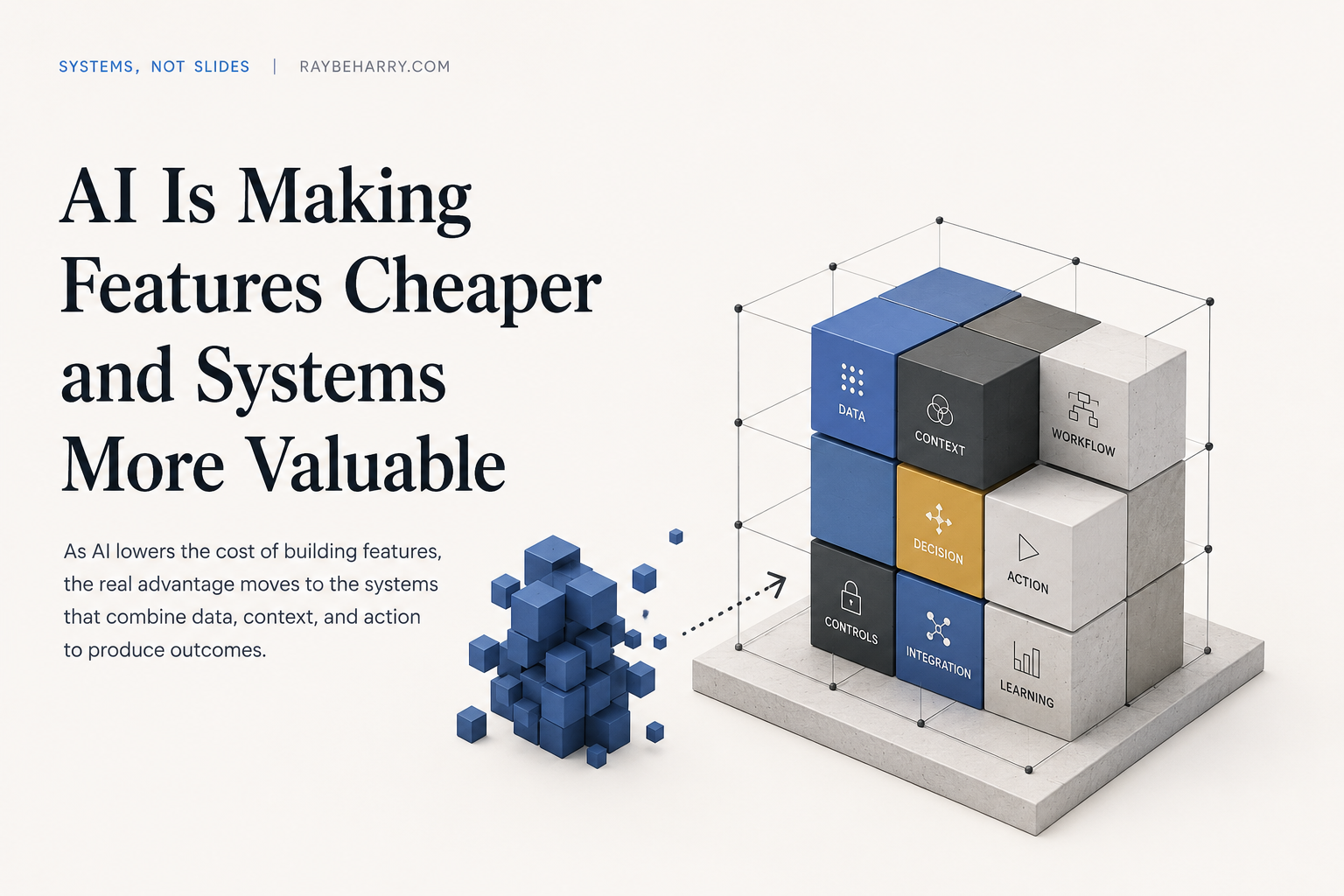
This is where the distinction between a feature and a system becomes important. A feature performs a function. A system combines information, context, workflows, rules and actions to produce an outcome consistently.
Consider two products that use the same underlying AI model. One has access to limited customer information and performs a relatively isolated task. The other understands the customer’s environment, draws on historical data, works across several systems, follows established business rules, knows when approval is required and can see what happened after an action was taken.
The intelligence may come from the same foundation model, but the products are not equivalent.
The second product has something around the model that is much harder to reproduce. That surrounding system becomes an increasingly important part of the product and, potentially, its competitive advantage.
Adding AI Is Different From Redesigning the Product
McKinsey’s research points to a similar pattern in how companies are adopting AI. Productivity gains are becoming widespread, while meaningful enterprise-level financial impact remains much less common. One characteristic of organizations reporting stronger results is that they are more likely to redesign workflows rather than simply introduce AI into existing ways of working.
There is a useful lesson here for product development.
Much of the first wave of AI development has focused on improving products that already exist. Companies have introduced conversational interfaces, automated manual tasks, improved recommendations and made it easier for users to create, find and analyze information. These improvements can save considerable time and make good products better.
The larger opportunity is to reconsider the workflow itself.
Most applications were designed around the limitations of the technology available when they were created. A user recognizes that something needs attention, opens an application, finds the relevant information, determines what needs to happen and then moves through a series of steps to make it happen. We have become so accustomed to those steps that they often feel like an inherent part of the work.
AI gives product teams an opportunity to revisit those assumptions.
A system can increasingly recognize that something needs attention, assemble the relevant context and help determine an appropriate response without waiting for a user to initiate every step. Depending on the situation and the controls in place, it may also be able to take action and track what happened afterward. Human involvement doesn’t disappear, but it can shift toward the decisions, approvals and exceptions where judgment is most valuable.
The result is not simply a faster version of the old product. The product starts to organize itself around the outcome the customer is trying to achieve rather than the sequence of tasks the customer has historically had to perform.
That is a much more significant design opportunity than adding AI to an existing feature set.
Agents Alone Won’t Create Much of a Moat
The same thinking applies to agents.
There is an understandable rush to add agentic capabilities to enterprise products. As the technology improves, agents will be able to handle increasingly complex work across more applications and business processes.
But the presence of an agent isn’t likely to be a lasting differentiator on its own. If most companies have access to similar foundation models and increasingly capable agent frameworks, simply having an agent will eventually become expected.
What matters is what the agent is able to work with.
An enterprise agent needs access to the right information and enough context to interpret it correctly. It needs to understand what actions are permitted, which rules apply, when approval is necessary and when a situation should be handed to a person. Just as importantly, the system needs some way to determine whether the action produced the intended result.
These are product decisions, not simply model decisions.
A product becomes more valuable when the intelligence is connected to the data, workflow, controls and expertise required to turn a recommendation into reliable action. It becomes more valuable again when the result of that action can inform what happens the next time.
Over time, that creates something much more difficult to copy than an agent.
It creates a system that understands how work gets done.
This Changes the Product Roadmap
None of this makes features or user experience unimportant. Customers still need products that solve real problems and are easy to use. The roadmap still matters.
What changes is the level at which product leaders need to think about differentiation.
If a capability can be reproduced relatively quickly, its presence on the roadmap may be necessary without making it strategically important. The more valuable questions concern what the product knows, where it fits into the customer’s operation and what becomes better because the product is there.
That may lead companies to invest differently. Proprietary data can become as important as another feature. Integrations may matter because they provide context, not simply convenience. Governance can become part of the value proposition rather than a compliance requirement. Domain expertise can be encoded into workflows and decisions instead of living primarily in services or documentation.
Measurement also becomes part of the product. If a system can see whether the action it recommended actually improved cost, speed, quality, risk or another meaningful outcome, it gains information that can make the next decision better.
That creates a different kind of product advantage. It isn’t based on having one capability that a competitor doesn’t. It comes from understanding the problem, the environment and the outcome better over time.
The Moat Is Moving
There has been plenty of debate about whether AI will replace SaaS or make traditional applications obsolete. That may be the wrong way to look at what is happening.
Software isn’t becoming less important. The source of its value is changing.
As individual capabilities become easier to create, there is less protection in the capability itself. More of the value moves into the context and workflow around it. As AI becomes capable of doing more of the work, controls, integrations and domain knowledge become more important. And as systems begin taking action rather than simply providing information, the ability to measure what happened and improve the next decision becomes part of the product.
The result may be a shift from products built primarily as collections of features toward products that operate more like systems for producing a business outcome.
For product leaders, that is a more consequential question than which AI feature to add next.
The technology for building individual pieces is getting cheaper and more accessible. The real work is figuring out which pieces belong together, what they need to know, how they should work and why a customer would choose that system rather than build or assemble an alternative.
AI may make it easier to build software.
It doesn’t make it easier to build a great product.

You may also like

Competitive Intelligence in Real Time
Designing Real-Time Intelligence for Sales