
Competitive Intelligence in Real Time
Outlearn the market before it moves
“You don’t win by reacting faster. You win by seeing the shift sooner.”
Most teams think they’re doing competitive intelligence (CI).
They have battlecards.
They screenshot pricing pages.
They paste competitor headlines into slides.
They run a quarterly “CI update.”
That’s not intelligence.
That’s a scrapbook.
In fast-moving markets, especially AI-driven ones, narratives shift in days. Pricing fences change quietly. Feature pages morph without a press release. Executives test positioning in a single LinkedIn post before it ever hits the homepage.
If you’re collecting artifacts, you’re already late.
As I write in Systems, Not Slides
Systems_ Not Slides eBook
, the job of modern PMM isn’t to ship more content — it’s to build systems that sense, adapt, and move the market. Competitive intelligence is no exception.
The shift is simple — and demanding:
-
From files to feeds
-
From facts to implications
-
From news to plays
Why Traditional CI Fails
Old-school CI has three fatal flaws:
-
It’s periodic.
Markets move weekly. You report quarterly. -
It’s descriptive.
“Here’s what changed.”
No one answers: So what should we do? -
It’s disconnected from action.
Sales doesn’t change talk tracks.
Web copy doesn’t update.
No counter is shipped.
CI that doesn’t change behavior is trivia.
CI that changes positioning, proof, and enablement within 72 hours?
That’s momentum.
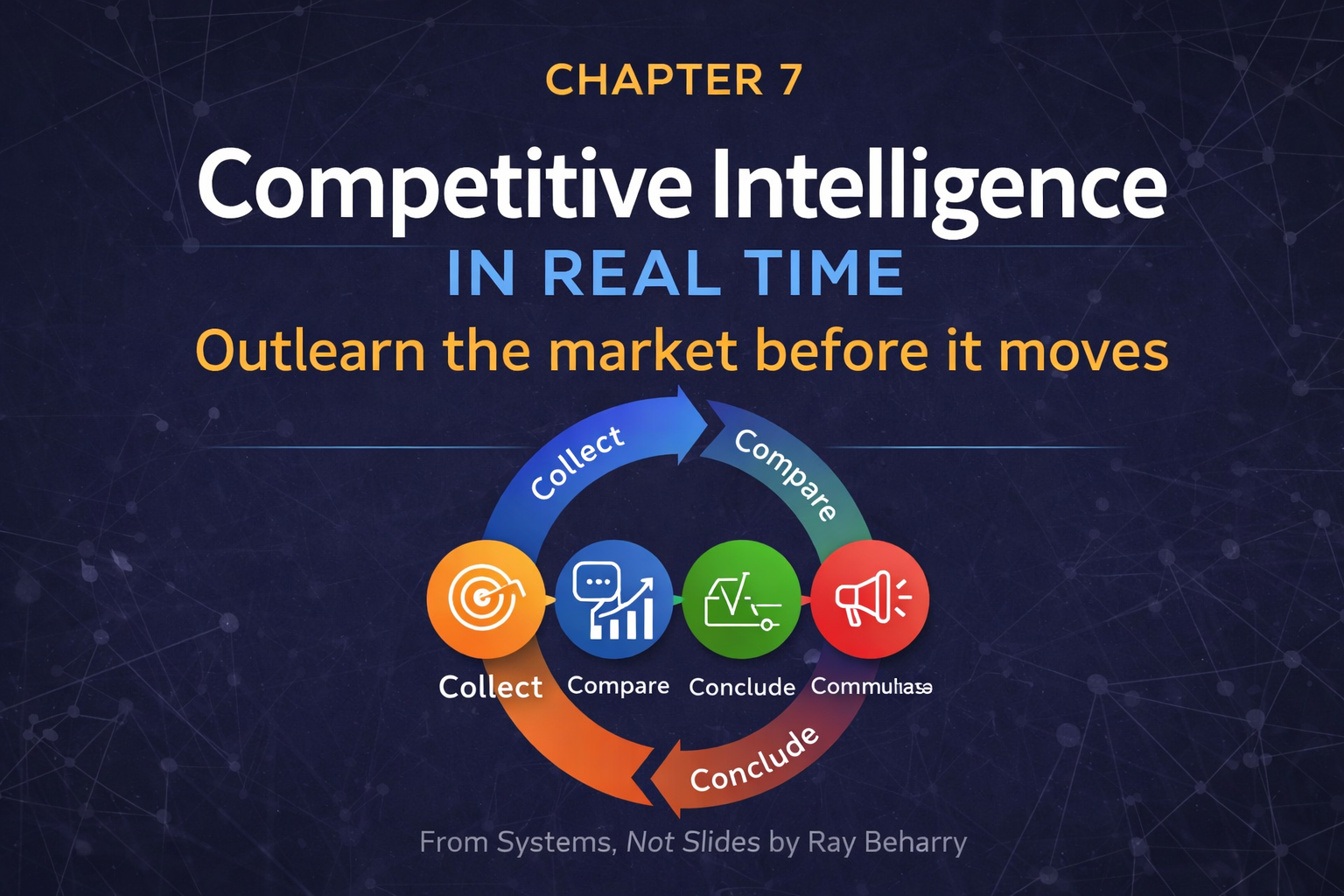
The Predictive CI Loop
In Chapter 7, I outline a loop that turns monitoring into movement:
Collect → Compare → Conclude → Communicate → Counter
Let’s break that down.
1. Collect Signals (Not Screenshots)
You’re not looking for noise. You’re looking for drift.
Monitor:
-
Homepage hero and subhead changes
-
Pricing tier adjustments and new “fences”
-
New hiring patterns (roles, seniority, geography)
-
Release notes and help center updates
-
Field signals (loss reasons, new objections, procurement friction)
One LinkedIn post is noise.
Copy drift + pricing tweak + hiring surge = pattern.
Patterns drive action.
2. Compare Against a 90-Day Baseline
Language changes before products ship.
If a competitor shifts from:
“AI analytics platform”
to
“Autonomous decision engine”
That’s not copy polish. That’s strategic direction.
Narratives move before roadmaps.
When you diff the last 90 days of messaging, you’ll see:
-
New nouns introduced
-
Old promises removed
-
Emotional tone shifts
-
ICP emphasis changes
This is your early-warning system.
3. Conclude With Hypothesis (Not Certainty)
Don’t pretend you have perfect foresight.
Instead, log:
-
Observed: What changed?
-
Inference: What might this signal?
-
Implication: What white space opens?
-
Confidence level: High / Medium / Low
-
Falsifier: What would prove this wrong?
This keeps CI strategic — not speculative.
4. Communicate in One Page or 60 Seconds
No 40-slide decks.
Every CI update should answer:
-
What changed?
-
Why it matters?
-
What we’re doing this week?
If it doesn’t change something, don’t ship it.
5. Counter Within 72 Hours
The 72-Hour Counter Kit includes:
-
Their move (one sentence)
-
Our angle (one sentence, on voice)
-
One proof to elevate
-
One landmine to avoid
-
Three SDR lines
-
Three discovery questions
-
Updated compare-page block
Not debate.
Deployment.
What Real-Time CI Looks Like in Practice
Example: Preempting a Narrative Pivot
A competitor quietly shifted messaging toward “autonomous workflows.” At the same time:
-
They posted IR-related job openings.
-
They highlighted a new GRC partner.
-
Their subhead added language around “no human intervention.”
Instead of reacting weeks later, the team reframed:
“Autonomy you can govern.”
They elevated audit and compliance proof, updated battlecards, and refreshed compare blocks in days.
Result:
Higher win rate in regulated enterprise accounts.
Not because they shouted louder.
Because they reframed earlier.
The Mindset Shift for PMMs
In this era, you are not:
-
A librarian of competitor slides.
-
A reporter of feature deltas.
-
A broadcaster of updates.
You are:
-
A trajectory reader.
-
A narrative architect.
-
A playcaller.
Competitive intelligence is no longer about tracking.
It’s about framing the debate before your competitor locks it in.
Guardrails That Matter
Speed without integrity destroys trust.
Build these in:
-
Public/consented sources only
-
Source links for every claim
-
Clear separation of hypothesis vs fact
-
No roadmap speculation
-
No rumor forwarding
Predictive does not mean reckless.
The Real Metric
Don’t measure CI by:
-
Deck views
-
Slack reactions
-
Number of tracked competitors
Measure it by:
-
Competitive win-rate delta
-
Renewal defense strength
-
Reduced late-stage stalls
-
Time-to-counter
If CI doesn’t improve momentum, it’s overhead.
If it does, it’s leverage.
The Takeaway
Competitive intelligence is not a presentation.
It’s a sensing system.
And when you build it right, something powerful happens:
You stop reacting to competitors.
You start shaping the market.
That’s the difference between playing defense
and designing the field.
If you want the full framework — including the Predictive CI Loop, 72-Hour Counter Kit, and the exact playbooks — Chapter 7 of Systems, Not Slides breaks it down step by step
Systems_ Not Slides eBook
.
Build the loop.
Ship the counter.
Outlearn the market before it moves.

You may also like
Dashboards Should Drive Decisions
Designing Real-Time Intelligence for Sales