Launches that Learn
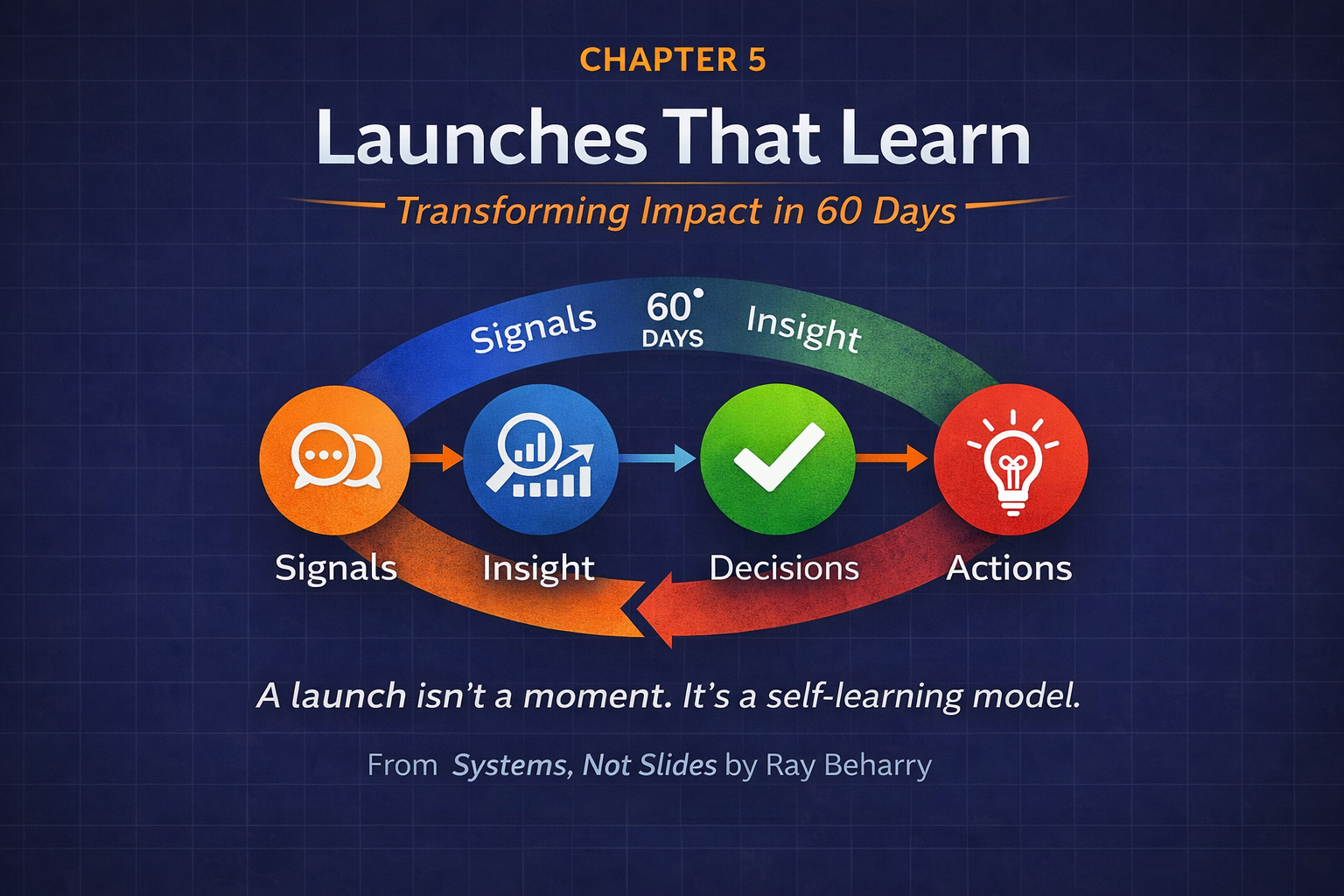
Chapter 5: The Launch Is No Longer a Moment — It’s a Self‑Learning Model
For years, launches have been treated like theater.
A date. A deck. A cascade of emails. A spike in activity followed by silence.
Then, inevitably, the post‑mortem:
“The market didn’t get it.”
“Sales didn’t use the messaging.”
“We’ll fix it in the next launch.”
That mental model is broken.
In modern product marketing, a launch is not an event — it’s a system. And like any good system, it should sense, learn, and adapt in real time.
If you remember one thing from this chapter, let it be this:
A launch should behave like telemetry, not theater.
Why the Old Launch Model Fails
Most launches fail quietly.
Not because the product is bad — but because learning stops too soon.
The traditional launch model assumes:
- Messaging is mostly “right” at GA
- Feedback arrives too late to matter
- Learning happens in quarterly reviews
But buyers don’t evaluate products in quarters. They evaluate them in conversations, clicks, objections, and moments of confusion.
If you’re not capturing those signals — and reacting to them — you’re flying blind.
The Reframe: Treat Your Launch Like a Self‑Learning Model
Instead of asking:
“Did the launch work?”
Ask:
“What did the market teach us this week?”
That shift changes everything.
A modern launch should:
- Make explicit narrative bets
- Be instrumented across every surface
- Run on a deliberate learning cadence
- Close the loop between marketing, sales, and product
- Produce institutional knowledge — not tribal memory
Let’s break that system down.
Step 1: Declare Your Narrative Bets
Every launch is a hypothesis.
The mistake teams make is pretending it’s not.
Before launch, force clarity by declaring three narrative bets — no more.
Examples:
- Trust: Buyers care most about credibility, governance, and proof
- Speed: Buyers value time‑to‑value and ease of adoption
- Control: Buyers want flexibility, extensibility, and autonomy
These are not taglines. They are beliefs about buyer psychology.
By naming them explicitly, you create something powerful:
- A shared mental model
- A way to measure resonance
- Permission to change your mind
If you don’t declare your bets, you can’t learn which ones are wrong.
Step 2: Instrument Every Surface
Most teams instrument funnels.
Very few instrument narratives.
A self‑learning launch tags everything:
- Web pages
- Emails
- SDR talk tracks
- Sales decks
- Demos
Each asset should carry simple metadata:
- Narrative (Trust / Speed / Control)
- Persona (CIO, Data Leader, Ops, etc.)
- Stage (Discovery, Evaluation, Validation)
This isn’t busywork.
It allows you to answer questions like:
- Which narrative drives deeper engagement?
- Where does confusion spike?
- Which personas are reacting — and which are stalling?
You can’t optimize what you don’t label.
Step 3: Run the 60‑Day Launch Rhythm
Learning needs a cadence.
One of the most effective systems I’ve used is a 60‑day launch rhythm:
- Day −30: Prep
Finalize narrative bets, instrumentation, and success signals - Day 7: First Read
Early signal scan — what’s landing, what’s not - Day 14: Pivot the Weakest Bet
Don’t polish the strongest message — fix the failing one - Day 30: Consolidate
Double down on what’s working, retire noise - Day 60: Evolve or Kill
Decide what becomes core messaging vs. what gets sunset
This rhythm forces discipline.
It replaces gut feel with structured learning.
Step 4: Close the Field Loop — Weekly
Your best launch data isn’t in dashboards.
It’s in conversations.
Tools like Gong, Chorus, or call transcripts are gold — if you review them intentionally.
A simple weekly loop:
- Pull 10–15 calls
- Look for narrative language buyers repeat (or reject)
- Identify new objections or reframes
- Adjust talk tracks immediately
Not quarterly. Weekly.
This is how launches stay alive.
Step 5: Publish the Launch Learnings Memo
Most teams learn — then forget.
Institutional learning requires ritual.
At the end of each launch cycle, publish a simple memo:
What we believed
What changed
What we’re testing next
This does three things:
- Builds organizational memory
- Signals that learning is success
- Makes future launches exponentially smarter
Over time, these memos become a competitive asset.
What This Means for Leaders
If you’re leading product marketing, growth, or go‑to‑market, the question isn’t:
“Did we launch on time?”
It’s:
“Did we build a system that gets smarter?”
Because markets don’t reward perfect launches.
They reward teams that learn faster than their competitors.
And that’s what Systems, Not Slides is really about.
Chapter 5 dives deeper into how to operationalize learning loops across launches, campaigns, and portfolios — turning go‑to‑market into a compounding advantage, not a recurring fire drill.

You may also like


Dashboards Should Drive Decisions

Competitive Intelligence in Real Time