
Your Messaging Isn’t Broken — Your Feedback Loop Is
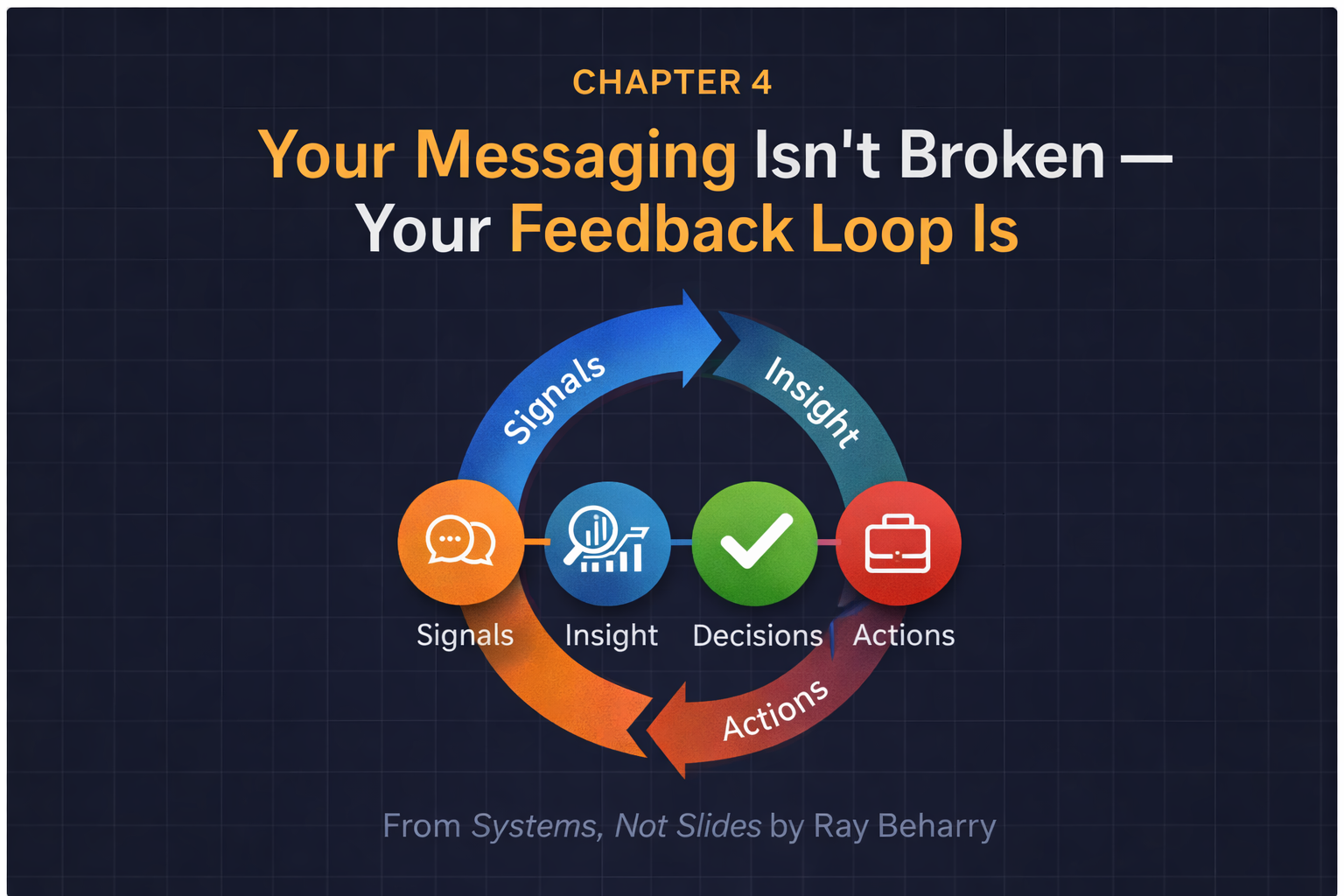
Most marketing teams say they want feedback.
Very few design systems to actually capture it — and even fewer turn it into action.
That’s the gap Chapter 4 of Systems, Not Slides is built to close.
In modern marketing, messaging doesn’t fail because teams lack creativity or data. It fails because insight lives in too many places, arrives too late, or never makes it back into the system that shapes decisions. Slides get updated. Campaigns move on. The learning is lost.
High-performing teams work differently. They build feedback loops — intentional, repeatable systems that connect what’s happening in the market directly back to how messaging is created, tested, and refined.
Why Feedback Loops Matter More Than “Better Messaging”
Traditional messaging workflows are linear:
Research → Positioning → Launch → Hope it works
Feedback, if it exists at all, shows up as anecdote, lagging metrics, or postmortems no one revisits. By the time insight surfaces, the team has already moved on.
Feedback loops break that pattern. They create a continuous cycle where real-world signals — from sales conversations, customer objections, win/loss data, and performance metrics — are captured early and fed back into the system while decisions still matter.
The goal isn’t more data.
The goal is faster learning.
Where the Best Signals Actually Come From
One of the biggest mistakes teams make is over-indexing on dashboards while underutilizing human signals.
Some of the most valuable feedback already exists inside your organization:
-
Sales conversations that reveal what resonates — and what doesn’t
-
Objections that stall deals
-
Language customers use to describe their own problems
-
Proof points that consistently unlock momentum late in the funnel
In Chapter 4, I argue that sales is not just a distribution channel — it’s a live testing environment. Every deal is a message test. Every objection is a signal.
But without a system, those signals evaporate.
Designing a Practical Feedback Loop (Without Overengineering)
Effective feedback loops don’t require new tools or complex processes. They require clarity on four things:
-
What signals matter
Not all feedback is equal. Focus on signals tied to buying decisions — not opinions. -
Where those signals are captured
CRM notes, deal reviews, enablement sessions, campaign performance — pick a few, not everything. -
How insight flows back into decisions
Messaging updates, enablement refreshes, campaign tweaks — feedback must change behavior. -
Who owns the loop
If everyone owns it, no one does. Feedback loops need clear accountability.
When these elements are in place, learning compounds. Messaging improves not because someone rewrote a slide, but because the system demanded it.
From Insight to Impact
The real power of feedback loops isn’t insight — it’s what happens next.
When feedback is operationalized:
-
Messaging sharpens faster
-
Sales alignment improves naturally
-
Campaigns get smarter over time
-
Teams stop debating opinions and start acting on evidence
This is how marketing moves from storytelling to decision intelligence — and from activity to impact.
The Shift That Changes Everything
Chapter 4 isn’t about listening harder.
It’s about designing marketing so learning is inevitable.
When feedback loops are built into the system, teams don’t need heroics, endless meetings, or constant reinvention. The work gets better because the system forces it to.
That’s the difference between slides that look good — and systems that perform.

You may also like


Designing Real-Time Intelligence for Sales

Launches that Learn