The book · The method · The system
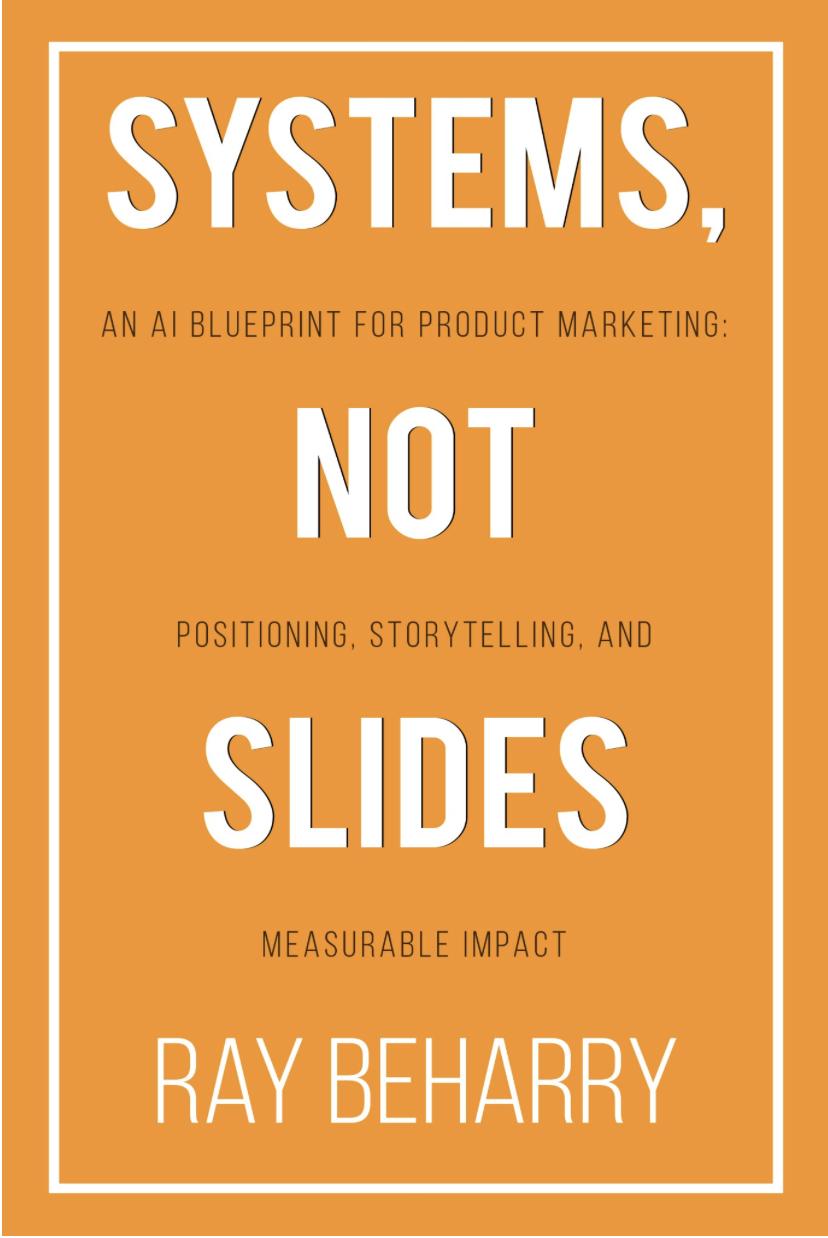
Systems, Not Slides
A practical blueprint for building intelligent marketing systems.
Written for product marketers who want impact, not just output. The architecture underneath applies to any function that has to turn signals into decisions every week.
Why I wrote it
Product marketing had the tools. It didn't have the system.
“They’re optimizing content, not capacity. They’re crafting slides, not systems. They’re writing copy, not building engines that can keep writing for them.”
- The problem
- Teams optimize the visible parts of the craft, such as messaging, competitors and features, and leave the invisible parts untouched: the systems, automation and feedback loops that create velocity.
- The philosophy
- Fewer, stronger ideas, scaled with AI and defended with evidence. Machines handle memory and volume; people own judgment, taste and the decision.
- Who it helps
- Product marketers and the leaders who manage them, and any go-to-market team that wants its work to compound instead of restarting every quarter.
- How it has been implemented
- The same architecture runs in the AI Marketing Department: 70 specialist agents and an AI Chief of Staff on Claude Code, free to download and run.
The argument
From disconnected activities to a connected operating model.
01 / 04
Disconnected artifacts
Most product marketing still ships as one-off assets: a positioning deck, a launch brief, a battlecard, a quarterly research report. Each is made by hand, goes stale on delivery, and teaches the next one nothing.
“They’re crafting slides, not systems.”
02 / 04
Organized into a loop
The same work, arranged as a loop: Sense → Synthesize → Create → Activate → Learn → Remember. Every artifact now has an input it depends on and an output that feeds the next stage.
“The GTM machine you’re building.”
03 / 04
Connected by shared memory
A Message Canon, a Proof Vault and an Enablement Source of Truth hold what the organization knows. AI generates from approved sources, and every pass through the loop writes back what it learned.
“Machine for memory, human for meaning.”
04 / 04
Measured to decide
The Impact Chain connects the loop to the business: Narrative Fit → Engagement Quality → Sales Momentum → Revenue Outcomes. A weekly Command Board turns the reading into one Stop, one Start and one Scale.
“Don’t measure to report. Measure to decide.”
How it fits together
Four layers, one body of work.
Each layer makes the one above it real. The thinking produces frameworks, the frameworks become tools, and the tools come together in a working system.
- 01
The Thinking
The book and its central argument: replace one-off assets with an operating system that learns every week.
The book - 02
The Frameworks
Five core loops and the methods around them: the Operating Loop, Impact Chain, LPNS, Learning Launch and Predictive CI Loop.
The frameworks - 03
The Applications
Playbooks, prompts, a weekly rhythm and a 60-day sprint that turn each framework into something a team can run this week.
Tools & prompts - 04
The AI Marketing Department
An implementation: 70 specialist agents in 14 departments and an AI Chief of Staff on Claude Code, with a shared knowledge layer and human approval gates.
The system
The core loops
If you remember nothing else, remember the loops.
“These aren’t slogans. They’re operating systems. Put them on a wall.”
Read the full blueprint.
Ten chapters, two bonus sections on prompting and building GPTs, and a terminology appendix.