What Leaders Get Wrong About Development Plans
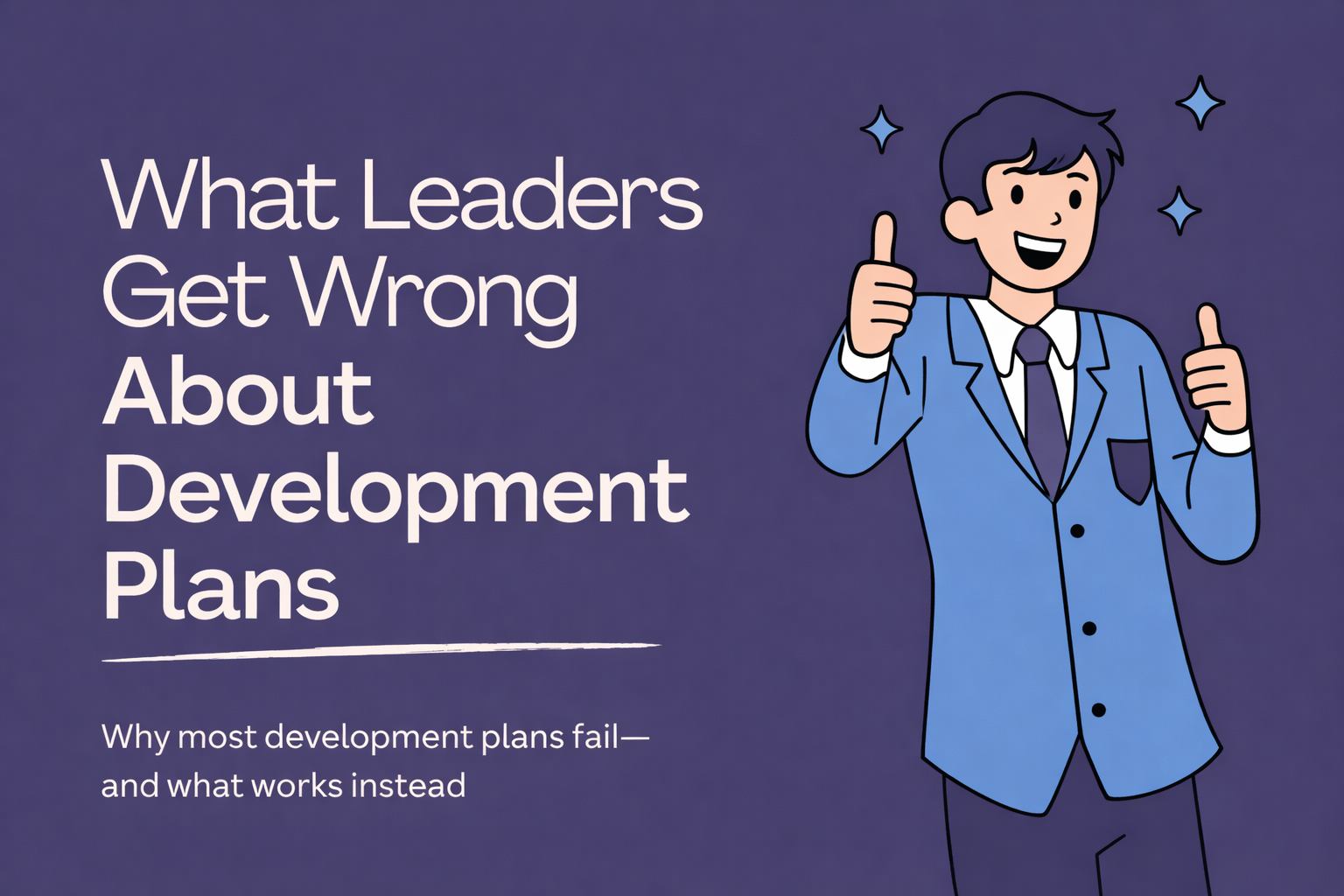
Most leaders believe in development.
They invest in training.
They ask people to complete development plans.
And yet—very few people actually feel developed.
That disconnect isn’t a motivation problem.
It’s a design problem.
We keep asking people to grow without giving them a clear, repeatable path to do so. We confuse good intentions with real outcomes. Development becomes a form to complete instead of a system to guide learning over time.
That’s why so many development plans get filled out once a year… and quietly forgotten.
What Leaders Get Wrong About Development Plans
Leaders don’t fail at development because they don’t care.
They fail because they misunderstand what development actually requires.
Most development plans break down in predictable ways. Growth is treated as an annual event rather than a continuous process. Learning is reduced to activities instead of insight. Generic training replaces thoughtful consideration of how people actually learn. Development is disconnected from real work, real challenges, and real outcomes.
The result looks responsible on paper—but rarely changes behavior, confidence, or performance. When development becomes performative, people disengage. Not because they lack ambition, but because they don’t see how growth actually happens.
Development Isn’t a Form. It’s a Learning System.
Real development doesn’t start with future aspirations.
It starts with honest reflection.
Before planning forward, people need structured space to look back. What actually moved? What stalled? What are they proud of? What surprised them about their progress?
Reflection grounds development in reality. Without it, growth stays abstract and disconnected from lived experience. With it, development becomes personal, meaningful, and actionable. This is the step most plans rush past—and why they fail.
Make Learning Explicit (or It Doesn’t Compound)
Most people are learning constantly, but rarely pause to name it. When learning isn’t surfaced, it fades. When it’s explicit, it compounds.
Taking time to articulate what changed how you think, what improved how you show up, and what actually made you better turns experience into insight. Once learning is visible, it can be reinforced, repeated, and applied intentionally instead of accidentally.
Optimize How People Learn — Not Just What They Learn
Learning doesn’t fail because people resist it.
It fails because it doesn’t fit.
People grow in different ways. Some learn best through hands-on projects. Others through mentorship, peer learning, or structured courses. Many stall not because they lack effort, but because the learning format doesn’t match the individual.
Development accelerates when leaders stop prescribing learning and start designing for how people actually grow.
Learning Without Application Is Just Information
Learning only matters when it changes behavior.
Development becomes meaningful when learning shows up in decisions, collaboration, execution, and outcomes. Without application, learning remains theoretical. With it, development turns into a performance multiplier—for individuals and for teams.
From Reflection to Action: A Repeatable Path Forward
Growth doesn’t happen once a year.
It compounds through repetition.
At its best, development becomes a continuous loop: reflect on experience, learn deliberately, apply in real work, adjust based on feedback, and repeat.
Strong development plans don’t try to do everything. They focus on a small number of priorities, learning methods that actually work for the individual, and clear actions that start immediately. That’s how growth becomes systematic instead of aspirational.
A Practical Guide: Turning Development Into a Learning System
Below is a structured way to turn development from paperwork into progress. This is designed to be used in real conversations—not just filled out and filed away.
1. Reflect on Last Year’s Development Plan
Purpose: Ground the conversation in reality, not just intentions.
Start by anchoring on what actually happened.
Ask:
- What were 2–3 goals from last year’s plan that you actively worked on?
- Which activities happened as planned—and which didn’t?
- What are you most proud of accomplishing?
- What surprised you about your progress, either positively or negatively?
Optional exercise:
Have each goal clearly labeled as:
- Achieved
- In progress
- Not started (and why)
This creates clarity without judgment—and sets the stage for real learning.
2. Surface What Was Learned
Purpose: Make learning explicit.
Learning is happening whether we name it or not. The difference is whether it compounds.
Ask:
- What new skills or knowledge did you gain?
- What did you learn about yourself—your strengths, limits, or interests?
- Which learning had the biggest impact on your confidence or effectiveness?
- What didn’t turn out to be as useful as you expected?
This step turns experience into insight.
3. Identify Learning Styles That Worked Best
Purpose: Optimize future development, not just add more training.
Not all learning methods work equally well for everyone.
Explore:
- Which approaches helped you learn most effectively?
- Hands-on projects
- Formal training or courses
- Mentorship or coaching
- Peer learning
- Self-study (articles, videos, labs)
- Which formats didn’t work well—and why?
- Did you learn more during structured time, or while doing real work?
Optional insight question:
If you had to learn a new skill quickly again, what would you do differently?
4. Apply Learning to Real Impact
Purpose: Connect development to outcomes.
Learning that isn’t applied doesn’t count.
Ask:
- How did you apply what you learned in your day-to-day work?
- Can you share a concrete example where learning changed how you:
- Made a decision?
- Collaborated with others?
- Delivered better results?
- What prevented you from applying some of the learning?
This is where development becomes performance.
5. Identify Gaps and Growth Areas for the Next Year
Purpose: Define forward-looking, meaningful goals.
Gaps should feel directional—not discouraging.
Explore:
- What skills or capabilities still feel underdeveloped?
- What challenges from last year do you want to handle better next time?
- What skills will be most critical for:
- Your role next year?
- Your longer-term career aspirations?
- The team’s priorities?
- What do you want to stop, start, or continue developing?
6. Set Direction for the Next Development Plan
Purpose: Turn reflection into action.
End with clarity and focus.
Define:
- What are 1–3 development priorities for the coming year?
- How do you want to learn those skills, based on what worked?
- What support do you need from:
- Your manager?
- The team?
- The organization?
Development only works when ownership and support are both explicit.
The Leadership Shift That Actually Matters
Asking people to “own their development” without designing the conditions for learning isn’t empowerment.
It’s abdication.
Leaders don’t need to control growth—but they do need to architect it.
If development isn’t working, don’t ask why people aren’t motivated. Ask whether you’ve built a system that makes growth inevitable.
The best leaders don’t hope people will grow.
They design environments where growth compounds.

You may also like
Designing Real-Time Intelligence for Sales
Launches that Learn