
Systems beat slides. Signals beat opinions.
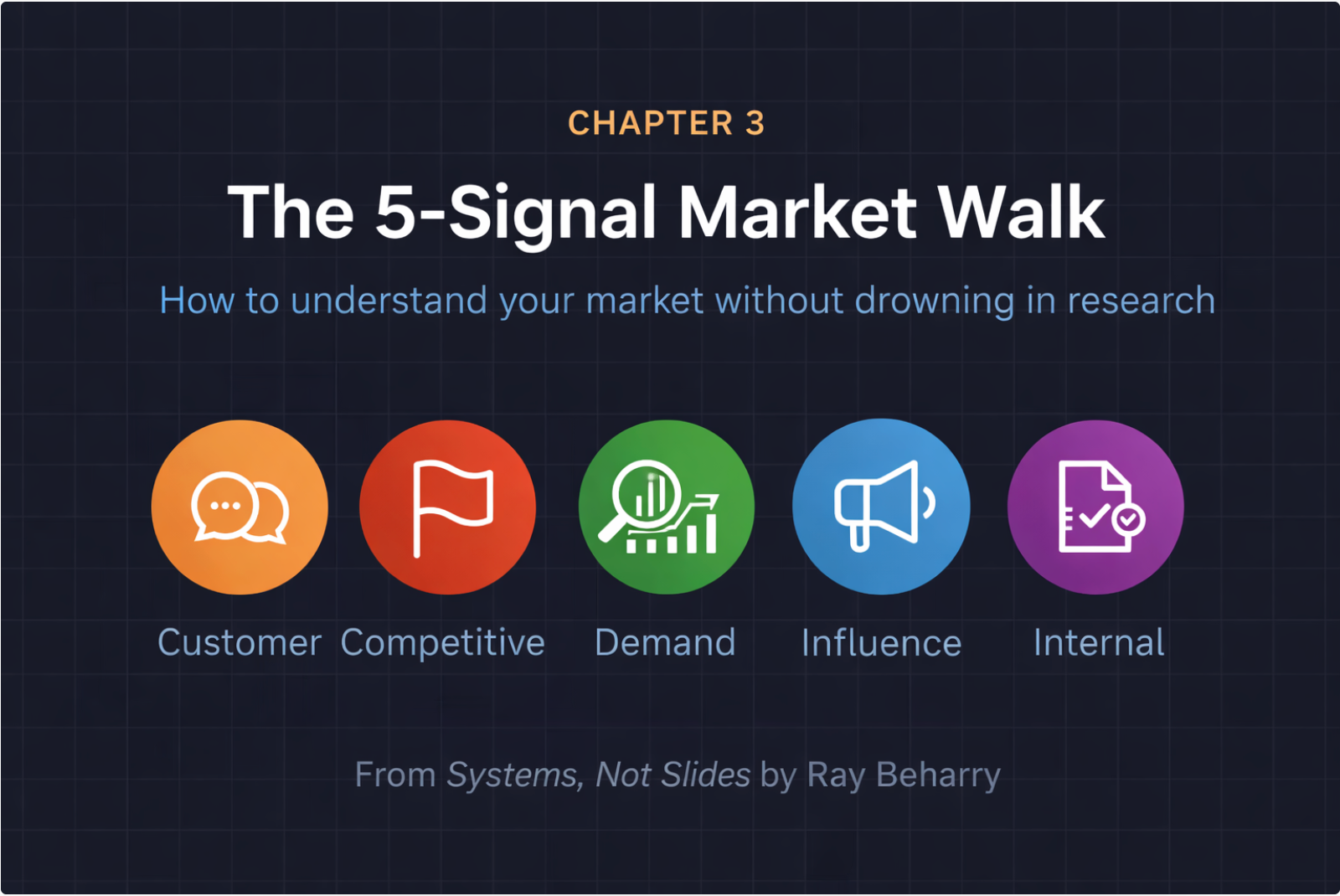
Systems Not Slides – Chapter 3: The 5-Signal Market Walk
How to understand your market without drowning in research
Most product marketing teams don’t have a research problem.
They have a signal problem.
There’s too much information, not enough clarity, and very little time to synthesize it into decisions that actually move revenue. Reports pile up. Decks get built. Nothing changes.
In Systems, Not Slides, Chapter 3 introduces a simple, repeatable way to cut through the noise: the 5-Signal Market Walk.
It’s not a research project.
It’s not a quarterly exercise.
It’s a fast, lightweight system you can run weekly—or even daily—to understand what’s happening in your market right now.
Why traditional market research fails in fast-moving markets
Classic market research assumes:
-
Stable categories
-
Slow-moving competitors
-
Long planning cycles
None of that is true anymore.
AI, pricing changes, feature launches, and new narratives can reshape a category in weeks—not years. If your insights are outdated by the time they reach Sales or Product, they’re already useless.
The 5-Signal Market Walk flips the model:
-
Less depth per signal
-
More signals in parallel
-
Faster synthesis
-
Continuous learning
The 5 Signals (overview)
The goal isn’t to become an expert in each signal.
The goal is to spot patterns early.
Here’s the high-level walkthrough.
1. Customer Signal
What customers are saying when they’re not talking to you directly
Look at:
-
Reviews (G2, App Store, Amazon, Reddit)
-
Community threads
-
Support tickets and FAQs
-
Social comments
You’re listening for:
-
Repeated frustrations
-
Language customers use before they adopt your vocabulary
-
What they praise competitors for
Output:
“Customers are struggling with ___ and value ___ more than we thought.”
2. Competitive Signal
What competitors are trying to change in buyer perception
Look at:
-
Product announcements
-
Homepage messaging changes
-
Pricing or packaging shifts
-
Blog and webinar themes
You’re not copying competitors—you’re identifying:
-
What they believe matters now
-
Where they’re over-indexing
-
What they’re ignoring
Output:
“Competitors are pushing ___ hard, which opens space for us to own ___.”
3. Demand Signal
What the market is actively searching for
Look at:
-
Keyword trends
-
Search spikes
-
Common pre-sales questions
-
Emerging category terms
This signal tells you what buyers are trying to solve before they talk to sales.
Output:
“Interest in ___ is rising, while ___ is declining.”
4. Influence Signal
What analysts, influencers, and operators are amplifying
Look at:
-
Analyst reports
-
Industry newsletters
-
LinkedIn themes
-
Conference agendas
This shapes buyer expectations—often before vendors realize it.
Output:
“The narrative is shifting toward ___, even if products haven’t caught up yet.”
5. Internal Signal
What your own data is quietly telling you
Look at:
-
Pipeline movement
-
Win/loss notes
-
Feature usage
-
Sales objections
This is the grounding signal—the one that keeps everything honest.
Output:
“Our data confirms ___ and contradicts ___.”
The key mistake teams make
Most teams collect these signals independently.
The power comes from walking them together.
When multiple signals align, you’ve found momentum.
When they conflict, you’ve found risk.
The 5-Signal Market Walk is about pattern recognition, not perfection.
How to run a lightweight version (today)
Here’s a simple way to try it without overengineering:
-
Spend 10–15 minutes per signal
-
Capture one sentence per signal
-
End with one question:
“What does this mean for our positioning right now?”
That’s it.
No decks.
No long docs.
Just clarity.
What comes next
In Systems, Not Slides, the full chapter shows:
-
How to automate signal collection with AI
-
How to turn signals into positioning inputs
-
How to operationalize this across Product, Marketing, and Sales
-
How teams use this to decide what not to do
This post gives you the walk.
The book gives you the system.
If your team is tired of reacting late—or building strategies on outdated insights—Chapter 3 is where the shift begins.
Systems beat slides. Signals beat opinions.

You may also like

Designing Real-Time Intelligence for Sales
Launches that Learn