The Evolution of Agentic AI
How Machines Are Learning to Think, Create, and Act on Their Own
AI is changing faster than any technology in history. But much of what we call “AI” today — chatbots, image generators, virtual assistants — is only the beginning of something much bigger.
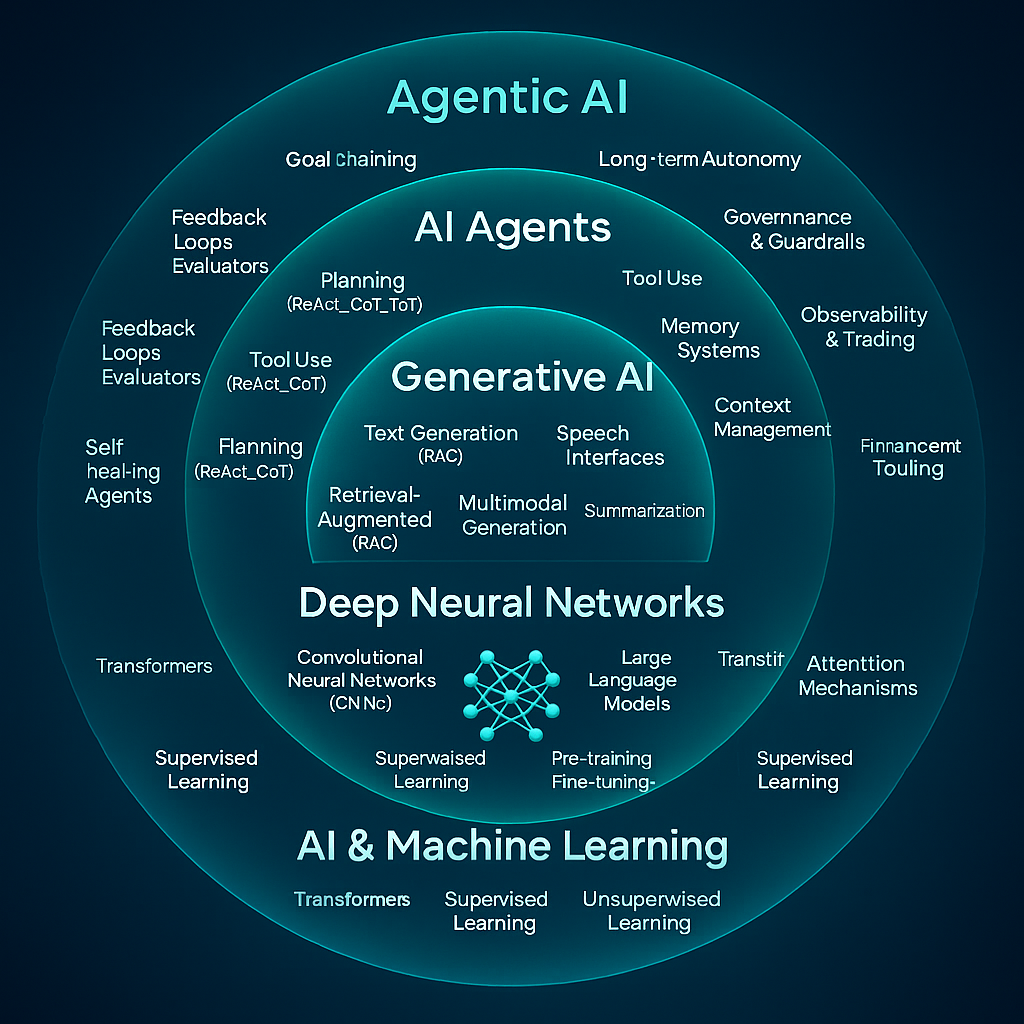
We are entering the era of Agentic AI: systems that not only generate content but can reason, plan, and act toward long-term goals. To understand how we got here, imagine AI as a series of expanding layers — each one building on the last — moving from raw data to autonomous intelligence.
Layer 1: AI & Machine Learning — The Foundation of Understanding
This is where it all starts. Machine Learning (ML) is simply teaching computers to recognize patterns in data — much like how we learn from experience.
- Feed it thousands of cat photos, it learns to recognize cats.
- Give it financial records, it learns to predict market trends.
- Provide medical scans, it learns to detect anomalies.
This layer includes methods like:
- Supervised learning: Training from labeled examples (e.g., “this is a spam email”).
- Unsupervised learning: Discovering hidden patterns without labels.
- Reinforcement learning: Learning by trial and error through rewards and penalties.
Think of this as the “learning to see and predict” stage — machines becoming observant students.
Layer 2: Deep Neural Networks — The Brain of Modern AI
If traditional ML is about recognizing patterns, deep neural networks are about learning from complexity. Inspired by the human brain, these networks use layers of interconnected “neurons” to detect meaning at different levels.
- The first layer might detect edges in an image.
- The next layer combines those edges into shapes.
- Another layer recognizes that those shapes form a face.
Deep neural networks power Large Language Models (LLMs) like GPT, speech recognition, and computer vision. They can learn context — not just “what” something is, but “how” it relates to other things.
This is the “learning to understand” stage — machines gaining a conceptual framework for the world.
Layer 3: Generative AI — The Creator
Here’s where things got exciting. Generative AI takes all that understanding and turns it into creation.
- Write essays or emails (ChatGPT)
- Generate art or videos (Midjourney, Runway)
- Compose music or design products
- Even generate new scientific hypotheses
But it doesn’t just “make stuff up.” It draws on what it has learned about language, structure, and context — and now, through RAG (Retrieval-Augmented Generation), it can even pull in real-time data to make its answers more accurate.
This is the “learning to express” stage — machines finding their voice.
Layer 4: AI Agents — The Operator
Once AI could generate, the next question was: “What if it could also act on what it generates?”
AI Agents are systems that don’t just create — they plan, reason, and execute. They can break big goals into smaller tasks, use external tools, remember past steps, and collaborate with other agents or humans.
Examples:
- A marketing agent can research a competitor, summarize findings, draft a campaign, and schedule posts — all autonomously.
- A data agent can query databases, clean data, run models, and report insights.
Technically, this involves frameworks like ReAct (Reason + Act), Chain-of-Thought reasoning, and Tool Orchestration (using APIs, plugins, or code).
This is the “learning to act” stage — machines taking initiative under supervision.
Layer 5: Agentic AI — The Autonomous Thinker
Here lies the frontier: Agentic AI. These are systems designed not just to act, but to set and pursue goals over time — while staying aligned with human values.
- Chain multiple goals together (e.g., “research → write → test → optimize”)
- Learn from feedback loops and self-correct
- Manage long-term memory and retain useful information
- Govern their actions under safety guardrails and ethical frameworks
For example, an Agentic business assistant might monitor company KPIs, identify declining trends, propose solutions, and autonomously test marketing strategies — all while tracking compliance and documenting its decisions.
This is the “learning to reason and self-govern” stage — machines developing a form of operational independence.
⚙️ Why This Matters
Most people think AI evolution ends with ChatGPT. In reality, that’s the midpoint. Agentic AI represents a shift from tools to collaborators — systems that help humans think, decide, and build faster than ever before.
But with power comes responsibility. As AI becomes more agentic, governance, ethics, and transparency will define its success. The goal isn’t to replace humans — it’s to amplify them.
🪞 The Human Parallel
You can think of this progression the same way humans learn:
- We observe and memorize (Machine Learning)
- We understand and generalize (Deep Learning)
- We create and communicate (Generative AI)
- We plan and execute (AI Agents)
- We reflect and evolve (Agentic AI)
The journey of AI mirrors our own — from data to decisions, from imitation to intention.
Final Thought
Generative AI creates.
AI Agents act.
Agentic AI decides.
The future of AI isn’t about machines replacing humans — it’s about designing intelligent collaborators that think, plan, and learn with us.

You may also like
Designing Real-Time Intelligence for Sales
Launches that Learn